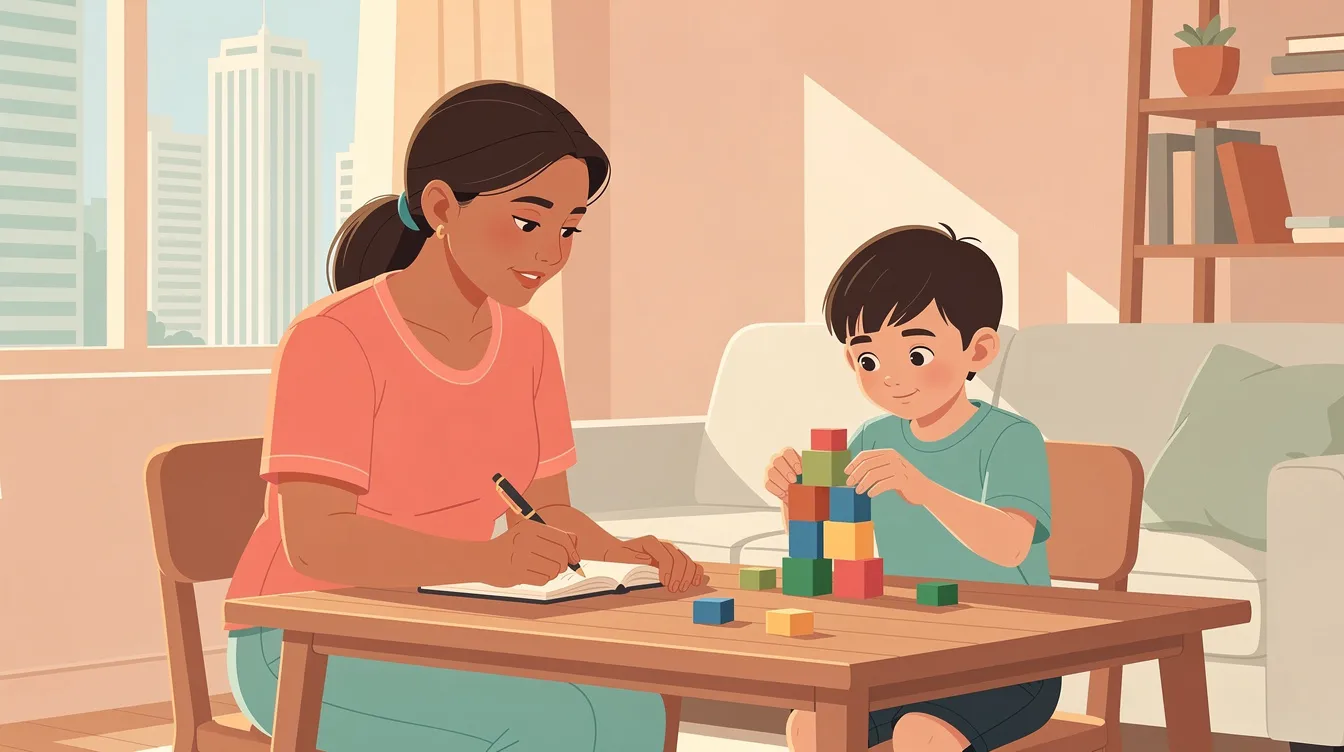
- Aggression in ADHD children is neurological, not personal. Hitting and throwing are overflow responses, not deliberate attacks on the helper.
- The three-step response — Safety, Calm, Report — gives helpers a clear protocol instead of guessing under pressure.
- What helpers must never do matters as much as what they should do. Retaliation, shouting, or physical restraint escalates danger and may constitute abuse.
- Employers who prepare helpers in advance — with scripts, safe zones, and regular check-ins — see significantly fewer crises and lower turnover.
ADHD Employer Guide Series
- 📖 Complete Employer Guide (Overview)
- 👁️ Observation Guide: The Helper's Most Important Skill
- 📋 Daily Routine: Schedules & Visual Cues
- 🛡️ You are reading: Hitting & Throwing: A Helper’s Response Guide
- 🌳 Outdoor Meltdowns: Practical Response Guide
- 📝 Free Observation Log (Printable)
Why ADHD Children Display Aggressive Behaviour
Hitting, throwing objects, kicking, and biting are among the most distressing behaviours a helper can face. But understanding why it happens changes how you respond to it.
ADHD affects the brain's prefrontal cortex — the region responsible for impulse control and emotional regulation. When an ADHD child becomes frustrated, overstimulated, or overwhelmed, their brain does not process "stop and think" the way a neurotypical child's does. The result is an immediate physical overflow: a slap, a thrown toy, a kick.
Three common triggers for aggressive episodes:
- Transitions: Being told to stop an activity they are absorbed in (e.g. screen time ending, leaving the playground). The shift itself feels like a threat.
- Sensory overload: Loud environments, crowded spaces, or too many instructions at once can push the child past their regulation threshold.
- Frustration with tasks: Homework, dressing themselves, or activities requiring sustained attention. When they can't do it, they don't have the words — so the body acts instead.
The critical insight for helpers: this is not personal. The child is not hitting you. They are hitting because their brain cannot process the emotion in any other way at that moment. This single understanding is what separates a helper who copes from one who burns out.
The Three-Step Immediate Response
When aggression starts, helpers do not need to improvise. They need a protocol. The following three steps work in the vast majority of indoor aggression situations and should be rehearsed before they are needed.
Secure the environment first
The helper's first priority is physical safety — for both the child and themselves. Move sharp objects, breakable items, or heavy toys out of reach. If the child is throwing things, step back to create distance but do not leave the room. If the child is hitting the helper directly, use open palms to gently block or redirect — never grab or hold the child down. The goal is to reduce the risk of injury, not to control the child.
Say nothing. Wait for the peak to pass
This is the hardest step. When a child is screaming, hitting, or throwing, every instinct says to react — to shout, to explain, to discipline. Don't. During an emotional peak, an ADHD child cannot process language. Talking makes it worse. Instead: stay nearby, keep your body language neutral (uncrossed arms, relaxed shoulders), and wait. Most episodes peak within 5–10 minutes. After the energy drops, the child will often become quiet, sometimes tearful. That is the moment to re-engage — gently, with a calm voice: "Are you okay? Let's sit together for a minute."
Log the episode and inform the employer
After the child has calmed, the helper should record the event using the observation log. Four things to note: (1) what happened immediately before the outburst (the trigger), (2) what the child did (hit, threw, kicked), (3) how long it lasted, and (4) what helped the child calm down. Then inform the employer — the same day, not the next day. Patterns only become visible when every episode is recorded consistently.
Tip: Employers can print these three steps on a single card and put it on the fridge. Under pressure, helpers don't remember articles — they remember what's in front of them.
Four Things Helpers Must Never Do
⚠️ These responses are dangerous. They escalate aggression, damage the child's trust, and may constitute abuse under Hong Kong law.
- Never hit back or use physical force. Slapping, pinching, pulling hair, or any form of corporal punishment is illegal. Even "light" physical discipline can traumatise an ADHD child whose nervous system is already overloaded.
- Never shout or raise your voice. Shouting adds noise to an already overwhelmed brain. It does not stop the behaviour — it intensifies it. The child hears volume, not words.
- Never threaten or use fear. "I'll tell your mum." "No dinner tonight." "You're a bad child." Threats create anxiety, which is a direct trigger for more aggression. The cycle gets worse, not better.
- Never physically restrain the child. Holding a child down, locking them in a room, or blocking their movement can cause panic and injury. The only exception is if the child is in immediate danger of harming themselves severely (e.g. running toward a window). In that case, minimal physical intervention to prevent injury is appropriate — and should be reported to the employer immediately.
If a helper is unsure whether a response is appropriate, the rule is simple: when in doubt, do nothing and report. Inaction is almost always safer than the wrong action.
How Employers Can Prepare Helpers in Advance
The single biggest predictor of whether a helper handles aggression well is not her personality — it's whether the employer prepared her. Helpers who receive clear guidance before the first incident respond better, recover faster, and stay longer.
Five things every employer should do before or during the first week:
- Name the behaviour explicitly: "Our child has ADHD. Sometimes he hits or throws things when he is frustrated. This is not your fault." Many helpers have never encountered ADHD. They need to hear, clearly, that the aggression is expected and not caused by something they did wrong.
- Walk through the three steps together: Don't just explain — rehearse. "If he throws a toy, what do you do first?" "If he hits you, what do you say?" Role-play builds muscle memory.
- Designate a safe zone: Choose a specific area in the home — a corner of the living room with cushions, the child's bedroom — where the helper can guide the child during an episode. Having a physical location makes the response concrete.
- Set the reporting expectation: "I want to know every time this happens. You will never be blamed for reporting." Helpers who fear being blamed for incidents stop reporting — and then employers lose visibility into their child's patterns.
- Schedule weekly check-ins: Ten minutes every Sunday evening. Three questions: What was the hardest moment this week? What seemed to help? What do you need from me? These check-ins are the single most effective retention tool for helpers in ADHD households.
For the complete employer framework including matching, onboarding, and long-term retention, read the Complete Employer Guide.
Recording Aggression: Using the Observation Log
Individual episodes feel chaotic and random. But when recorded consistently over two to four weeks, clear patterns emerge: the child is more aggressive after school, or when a certain food is eaten, or during transitions between activities. These patterns are exactly what therapists and paediatricians need.
Our free ADHD Observation Log is designed for helpers with limited English or Chinese. It uses checkboxes and simple fields:
- Date and time of the episode
- What happened before (trigger) — select from common options or write freely
- What the child did — hit, threw, kicked, screamed, other
- How long it lasted — approximate minutes
- What helped — what calmed the child down
Print it and keep it in the kitchen or on the helper's desk. The key is consistency: even a 30-second entry after each episode builds a data set that transforms therapy sessions from guesswork into targeted intervention.
For a deeper look at how observation supports the child's development, read: Observation Guide: The Helper's Most Important Skill.
Frequently Asked Questions
Need a Helper Who Can Handle the Hard Moments?
DuckDuckDay matches helpers to ADHD families based on patience, observation skills, and structured-execution ability. Talk to our consultant team — no obligation.
WhatsApp Us Free